
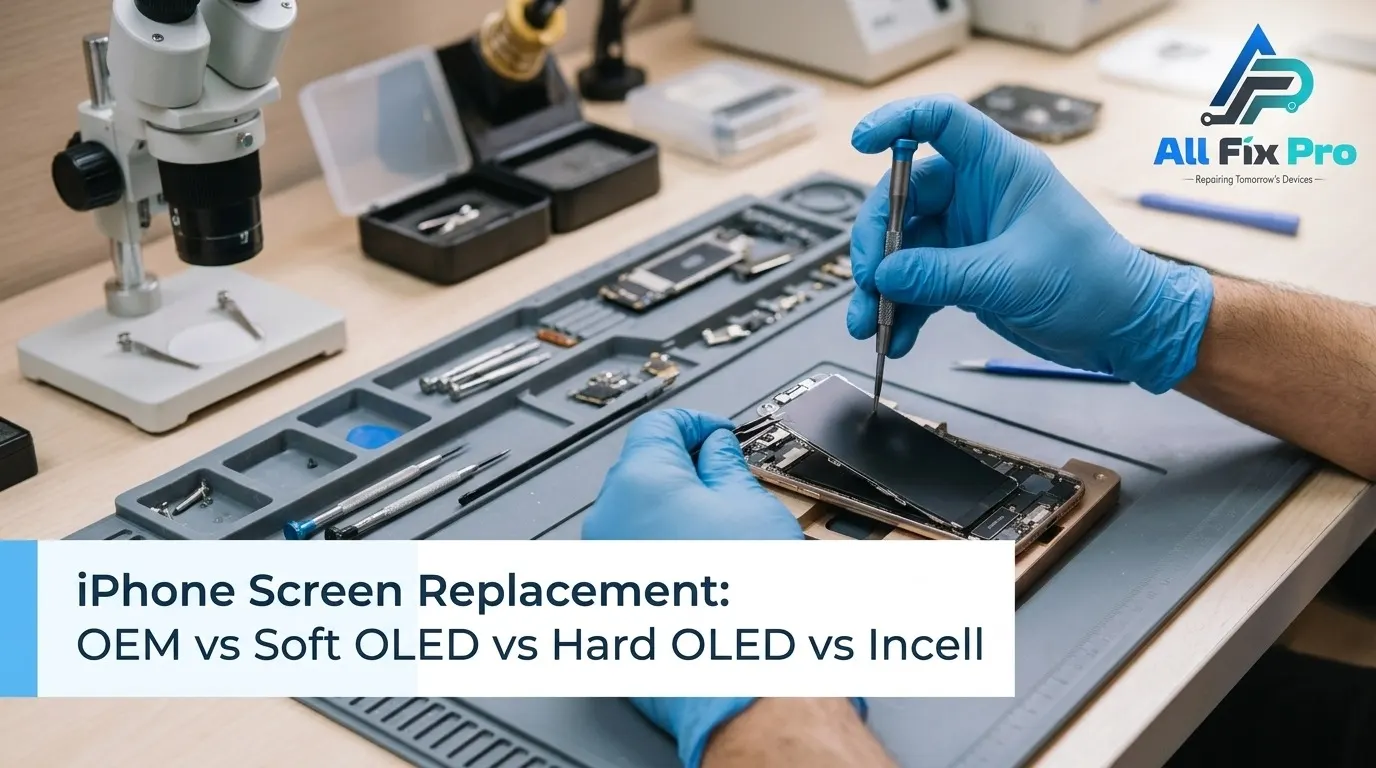
You crack your screen, call three shops, and get three prices with almost no explanation. The gap usually sits inside the panel. This guide explains each option so you can compare quotes fairly and ask better questions before you hand over your phone.
OEM vs Aftermarket iPhone Screen: What the Terms Mean
OEM means original equipment manufacturer. In repair shops it usually describes a screen built to Apple’s standard, or a genuine panel reused on a new frame. Aftermarket covers everything else, made by third-party factories at very different quality levels. A quote that only says “OEM” or “aftermarket” tells you little, so ask for the exact panel type.
Different Types of iPhone Screen Replacements
Most shops offer four tiers: OEM, soft OLED, hard OLED and incell LCD. Price falls as you move down the list, and so does similarity to your original display.
Genuine Apple Screen vs Aftermarket
A genuine Apple screen matches factory brightness, color calibration and touch response, and gives you the best chance of keeping True Tone. It also costs the most. Aftermarket panels trade some precision for price, and the gap ranges from barely noticeable to obvious. You can see the repairs we handle on our phone repair service page.
Soft OLED vs Hard OLED iPhone
Both are OLED, so blacks look deep and each pixel lights on its own. The difference is the base layer. Soft OLED uses a flexible plastic base, the approach Apple uses, so it typically delivers sharper detail, smoother touch and better brightness. Hard OLED uses a rigid base that costs less but cracks more easily from edge impacts and may draw more power. Between the two, soft OLED is usually the stronger pick.
Affordable Incell vs OLED iPhone Display
Incell is an LCD with the touch layer built in, which keeps it affordable. Expect lighter blacks, narrower viewing angles, lower peak brightness and slightly higher battery use. On an older or backup phone, that trade can make sense. On an iPhone that came with OLED, you will likely notice the downgrade in a dark room.
Are Aftermarket iPhone Screens Good?
Some are. A well-made soft OLED can be hard to tell from the original in daily use, while a poor one may show dim brightness, a green tint or laggy touch within months. Quality depends on the factory and the shop’s testing, not on the word “aftermarket.”
Factors That Affect iPhone Screen Quality
- Panel technology: OLED or LCD, flexible or rigid
- Brightness and color calibration
- Touch response, especially near the edges
- Frame and adhesive fit, which affects sealing
- Warranty length and how the shop handles defects
iPhone Screen Replacement Stockton CA
Searching for iPhone Screen Replacement Stockton CA? Run the same checklist with every local shop. Ask which panel types they stock, whether you can see the part before installation, and how long the warranty lasts. You can check costs on our pricing page and book a repair online.
Best iPhone Screen Replacement Option
The best iPhone screen replacement option depends on your phone and budget. For a newer iPhone you plan to keep, choose genuine or OEM-grade. For a balanced price, soft OLED works well. For an older or temporary phone, incell is acceptable. Unsure whether a new screen is worth it? Read our guide on whether to repair or replace your phone, or compare DIY screen repair vs professional repair. Once the new display is in, protect it with an iPhone screen protector.
Frequently Asked Questions
What is the difference between OEM, soft OLED, hard OLED and incell iPhone screens?
OEM matches original quality. Soft OLED is flexible and close to it. Hard OLED is rigid and cheaper. Incell is an LCD with built-in touch, the budget option.
Which iPhone replacement screen is closest to the original?
A genuine Apple or OEM-grade screen is closest. Among aftermarket choices, a quality soft OLED comes nearest in brightness, color and touch feel.
Is an incell screen bad for my iPhone?
Not harmful, just different. Blacks look lighter and brightness is lower, so it suits older phones better than OLED models.
Is soft OLED better than hard OLED?
Generally yes. Soft OLED is flexible, sharper and tougher at the edges, while hard OLED is rigid, cheaper and easier to crack.
Do aftermarket iPhone screens affect battery life?
Sometimes slightly. Incell and hard OLED panels can draw more power than original or soft OLED screens.
Will Face ID or True Tone work after a screen replacement?
Face ID usually works because it uses separate sensors. True Tone depends on original display data, so non-genuine screens may lose it.
Are replacement screens as bright and color accurate as the original?
Genuine screens match. Quality soft OLEDs come close, while hard OLED and incell typically show lower peak brightness and less accurate color.
How can I tell what type of screen my repair shop is installing?
Ask for the panel type in writing, request to see the part before installation, and test brightness, color and touch at pickup.
Does the screen type affect touch sensitivity or durability?
Yes. Genuine and soft OLED screens feel most responsive. Hard OLED cracks more easily, and low-grade incell can feel less sensitive at the edges.
What questions should I ask a repair shop before replacing my screen?
Ask about panel type, warranty, True Tone support, testing process and price differences, plus what happens if the screen fails.
Conclusion
Understanding the OEM vs aftermarket iPhone screen choice saves money and frustration. Match the panel to your phone and budget, get specifics in writing, and pick a shop that explains its parts openly. Questions before you decide? Contact us.